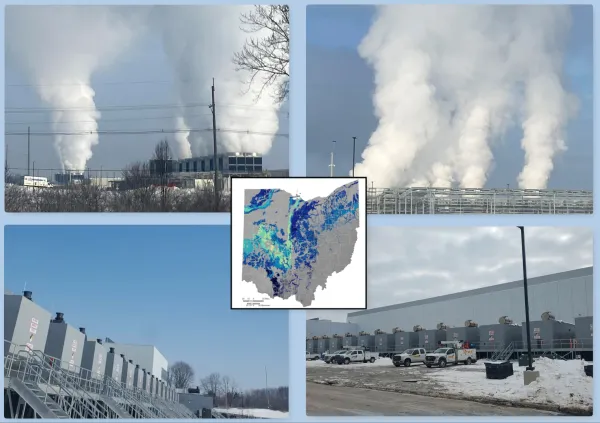
What many may not be aware of is that a high-yielding aquifer lies deep under most of Central Ohio. Keeping the aquifer on the down-low, so to speak, was perhaps the plan by local power brokers who foresaw how major corporations would someday come to our region seeking vast amounts of water for industrial use.
That day has arrived, as Google and other tech behemoths take millions of gallons daily from the aquifer and local groundwater that have fed this aquifer for thousands of years, if not longer. Also, utilizing the aquifer is Columbus Water and Power, the city department which provides potable water for 1.4 million residents.
According to Google, the Far South Side data center used 177 million gallons in 2024 when it was just coming online. Its data center in Lancaster took 207 million gallons that year and in New Albany, 405 million. Of Ohio’s 200-plus data centers, roughly 130 are in Central Ohio.
Coincidentally, Columbus City Council voted 9-0 last November to raise water and sewer rates across the city and suburbs with the average annual bill going up $100.
Recently, a massive cloud appeared over Google’s Far South Side sci-fi-looking data center that is just several hundred yards from residential neighborhoods and a casino. More large residential projects are in the works nearby. Steam emissions were pouring out of cooling towers and witnessed for miles. It was well below freezing that day, but this is proof of what it takes to cool IT equipment needed to power AI and the global cloud infrastructure.
The Free Press posted the pictures to our Facebook page, and all hot steam broke out. Over 100,000 views and hundreds of comments. Some blasted us for asking if this cloud contained pollutants and PFAS or “forever chemicals.” Others posted “Yes,” Google’s data center emissions are polluted, and during summer months will increase levels of humidity in the surrounding area.
“It’s definitely moisture from the cooling towers but I guarantee you it’s not just water. All of the cooling system water is treated with anticorrosion and other chemicals to maintain the system internally,” stated one post.
“Remember, seventh grade Life Science?” asked another post. “80 percent of the water used by data centers is pulled from the aquifer and released as steam, which travels far. Only 20 percent is returned – contaminated – to the ground as ‘blow-down.’ This leads to dried up rural wells and an ultra-concentrated municipal water supply full of contaminants, minerals.”
Other posts argued what can be described as a more practical answer but also concerning, “So I guess we should remove every oil refinery, steel mill, food processing facility, textile mill, petrochemical processing facility, because they pollute.”
We sent Google some questions about its Far South Side data center seeking specifics and we received the following:
“Google takes a climate-conscious approach to cooling its data centers and continues to deliver on commitments to champion responsible water use,” stated Jessica Ryan, an outsourced Google spokesperson from Columbus.
Obviously, the absolute truth these days is so very elusive. But after the Free Press posted the emission pictures a worker reached out to us with his own photos taken from inside the data center where there are armed guards, they said.
“Data centers use diesel generators. All those square boxes are fuel tanks [both pictured above],” stated our source who will remain anonymous. “They generally run almost all day. I took that picture and many others at this DC. They also use industrial-sized power banks on the inside of the building.”
These diesel engines, they said, “Send power to these power distribution banks that average 440 volts.” Four hundred forty volts equates to 88,000 watts of power – a typical American home requires 5,000 to 7,000 watts. “There is probably north of 500 of these in this data center.”
The source revealed more concerns which Google doesn’t speak to: “I do know that inside of each data hall there are thousands of gallons of glycol in IBC containers.”
According to the Environmental and Energy Study Institute, “The use of glycol-based thermal fluids in data centers is a significant contributor to emissions. These fluids are used to cool high-performance servers and equipment. The emissions associated with these fluids can include nitrogen dioxide and tiny, inhalable particles, which can harm lung health and contribute to premature deaths.”
Supporting this is a recent report from the Community & Environmental Defense Services (CEDS) that says living within a half mile radius of a data center means a greater chance of lung issues and premature death. Also alarming is how the Ohio Environmental Protection Agency (EPA) – in an effort to attract more data centers to Ohio – is seeking to loosen regulations on data-center wastewater discharges into local groundwaters.
Not all the water Google takes is turned into steam. Just like Google, however, Columbus Water and Power offered vague answers as to where the Far South Side data center discharges its wastewater.
“If discharging to the Publicly Owned Treatment Works, the wastewater would be treated at one of our water reclamation plants. The City of Columbus Industrial Pretreatment Program may sample wastewater discharges from any industrial user that discharges to the Publicly Owned Treatment Works,” they stated in an email.
One local environmental activist suggests this statement “sounds like a generalization that could lack some accuracy.”
“The local sewage system means that they put it down the drain. That would usually mean that the water would go to the local water treatment plant. That would be a big load for these already overloaded systems! Particularly Columbus,” said Pat Marida, a coordinator with the Ohio Nuclear Free Network.
Bruce Miller was once a Far South Side area commissioner who was forced out by city officials after he pushed back against Zone In, the overhaul of zoning code passed by City Council in 2024. Zone In, claimed city officials, is going to “streamline” the development process.
What that truly meant, says Miller, was that area commissions were no longer allowed to give recommendations or push back on new developments unless one of the few commissions with architectural review powers.
“They wanted area commissions to start ignoring neighborhood concerns,” he says, “yet we had hundreds of residents with environmental concerns. We were told [Google] wasn’t our concern by the Department of Neighborhoods high ranking staff.
“Hundreds of Southside and Far South Side resident voices were flat out ignored because the city had pre-determined they wanted this project and that City Hall knew what’s best for the Far Southside even if it sacrificed the local residents’ health, housing, jobs, water, food and safety.”